MENU
WELCOME, EXPLORERS!
Join us at Moab Giants for a prehistoric adventure filled with life-sized dinosaurs, interactive discoveries, and unforgettable family fun.
🕒 OCTOBER OPENING HOURS
Open: Monday, Tuesday & Thursday–Sunday
Closed: Wednesdays
Hours: 10:00 AM – 6:00 PM
🎟 Last Admission: 5:00 PM
🕒 NOVEMBER OPENING HOURS
Open: Thursday–Monday
Closed: Tuesdays & Wednesdays
Hours: 10:00 AM – 5:00 PM
🎟 Last Admission: 4:00 PM
🦖 YOUR ADVENTURE INCLUDES
A scenic outdoor trail featuring life-sized dinosaurs
Interactive indoor exhibits for curious explorers
Incredible photo opportunities for the whole family
Hands-on experiences for adventurers of all ages
Bring the whole family for a day of discovery, excitement, and unforgettable memories in Utah’s dinosaur country!
We can’t wait to welcome you on your prehistoric adventure!
📲 Follow @moabgiants for the latest updates, special events, and more.
Diet : Carnivorous
Habitat : Arid environment with fields of sand dunes and intermittent streams
Length : 6-8 feet (1.8-2.5 meters)
Weight : 55-66 lb (25-30 kg)
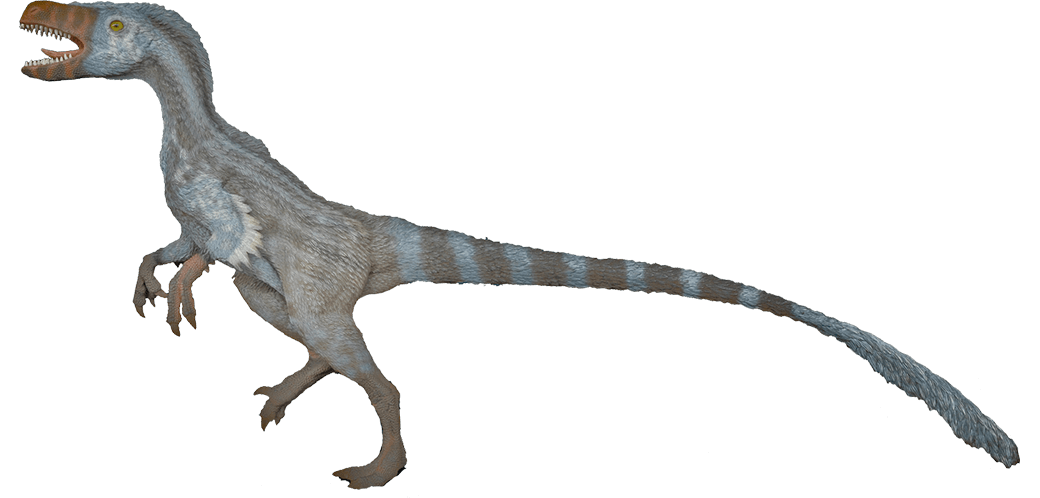
Velociraptorichnus means speedy thief. Dromaeosaurids such as Velociraptor only left two toe prints when they walked because the sickle-clawed inner toe was raised off the ground, in a retracted position like a cat’s claw. In 1995 just such a distinctive small two-toed track was described from the Cretaceous of China and named Velociraptorichnus. The possible track of this kind is also found in the Cedar Mountain Formation of Mill Canyon tracksite near Moab.
Velociraptor which means “swift seizer” or “swift thief” was named because it had the build of a runner. It was a small but ferocious predator. Despite the film Jurassic Park where it was depicted as less swift than a cheetah, and less smart than a chimpanzee Velociraptor nevertheless was swift, smart and equipped with sharp teeth, large eyes, long clawed fingers and toes. It was no larger than a wolf. Its most distinguishing and frightening feature was a sickle-like claw on the second toe of its hind foot. The significance of this claw was not realized until the 1964 discovery of Deinonychus, a related predator (raptor). With that find, the claw was understood to be a slashing weapon, used by dinosaurs like Deinonychus and Velociraptor to attack. Like Deinonychus, and possibly Utahraptor, it may have hunted in packs. Although Velociraptor and Utahraptor fossils have never been found in groups like Deinonychus their parallel trackways have been found as a group in China. Velociraptor was probably well-adapted for capturing and holding swift-moving, lightweight prey. One spectacular Velociraptor specimen found in the Gobi Desert in 1971 showed the animal grasping a Protoceratops skeleton. Protoceratops was thought to be struggling to defend itself or its eggs from the attacking Velociraptor and both animals died simultaneously.